Spread of Armed Conflicts
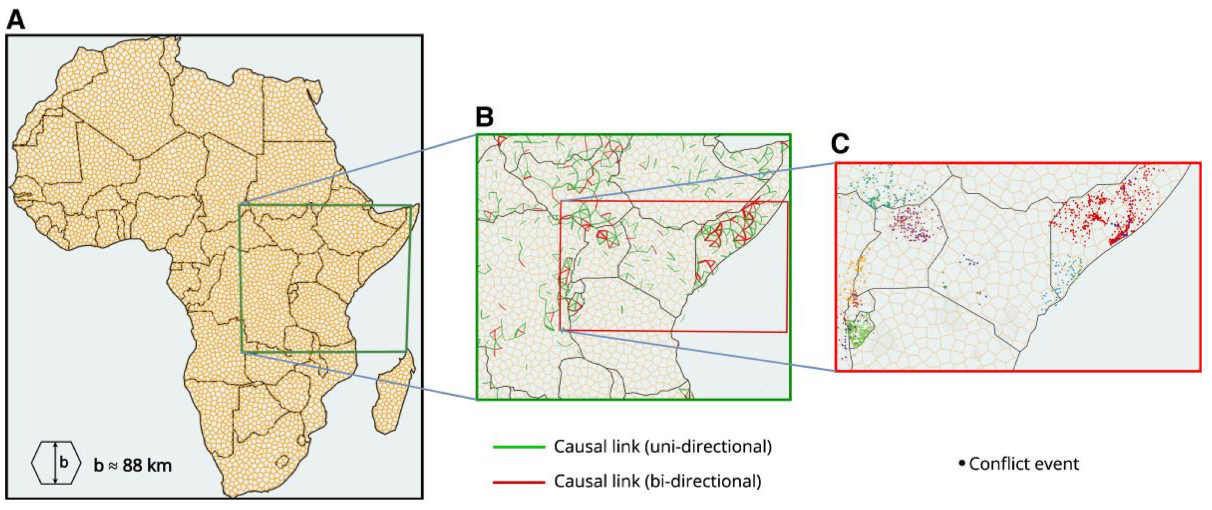
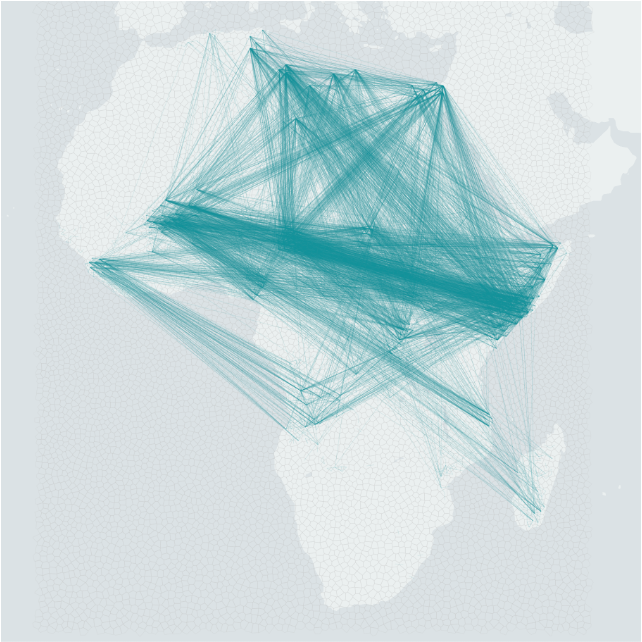
During my internship in the PoETs group at the Complexity Science Hub in Vienna I explored how I could generalize the assumptions of an information theoretically informed model of conflict spread my group has built. My supervisors were Eddie Lee and Niraj Kushwaha. The original model only accounted for dependence between unique conflict events locally. I extended the model by modeling dependence on a larger spatial scale by means of statistical copulas and building causal links between events by using transfer entropy. Please find the abstract of my final talk as well as the slides below.
Abstract
Understanding armed conflicts quantitatively and systematically is crucial for uncovering the mechanisms of conflict spread and mitigating their conflagration with informed decisions. My groups previous work has fruitfully shown that conflicts can be described by causally connecting unique conflict events by means of information-theoretic measures on varying temporal and spatial dimensions. The minimal assumption that the presence of conflicts spread locally leads to chains of conflict events, or “conflict avalanches,” which proved to closely resemble findings from field research. In order to more closely resemble social spreading processes, I explored how extending the model to permit spread to spatially distant conflict sites influences previous results. For this, I construct graphs for causal connections between conflict sites in Africa for a range of distances. Findings demonstrated that taking into account these interactions between spatially distant conflict sites loosely corresponds to increasing the spatial scale in the original model, promoting its validity.
Resources
A presentation of my results can be downloaded here:
Please find the code on my GitHub.