Spatial Inequality on the German Labour Market
Following on research by Luis Bettencourt on urban scaling and investigations by Pierre-Alexandre Balland on the concentration of complex economic activities in large cities, I investigated why economic opportunities and welfare concentrate in large German cities. My supervisor was Marc Keuschnigg.
Abstract
The massive growth in urbanisation carries with it a need to understand the economic attractiveness of cities and to structure the urban-rural transition socially just. It is well established that economically profitable opportunities and welfare concentrate in cities. Explanations of the phenomenon which relate the concentration of beneficial economic conditions in cities to their complexity have recently gained prominence. In this light, the present work investigates the relationship between the spatial concentration and the complexity of industry sectors and occupational groups on the German labour market using a novel dataset of job offerings. The results reveal that job offerings originating from more complex industries and occupations are significantly over-represented in large cities. Crucially, the results also show that with larger city size, jobs in the same occupational group get more complex and that this pattern gets more pronounced with increases in the required skill and specialisation level. Taken together, the findings stress the fact that cities are crucial for the emergence of highly profitable economic endeavours. Yet, it is illustrated that not all economic actors and social groups can benefit equally from the profitable economic conditions in cities. This poses challenges to the future dynamics of spatial inequality.
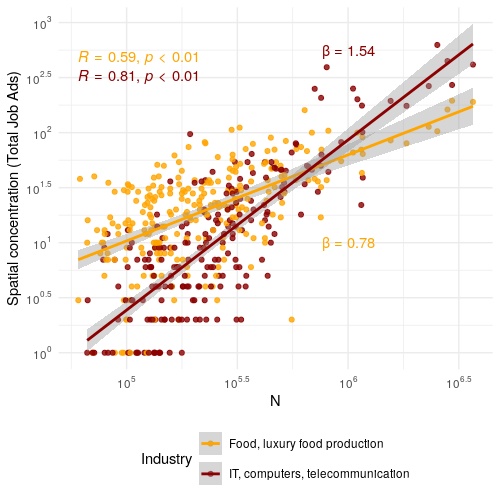
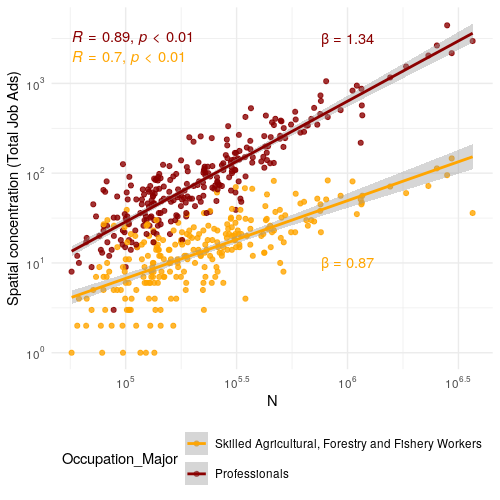
Figure above: The Spatial concentration of jobs on the German labour market. Scaling relations between the population of a Labour Market Area and the total number of job advertisements recorded in different (left) industries and (right) occupations.
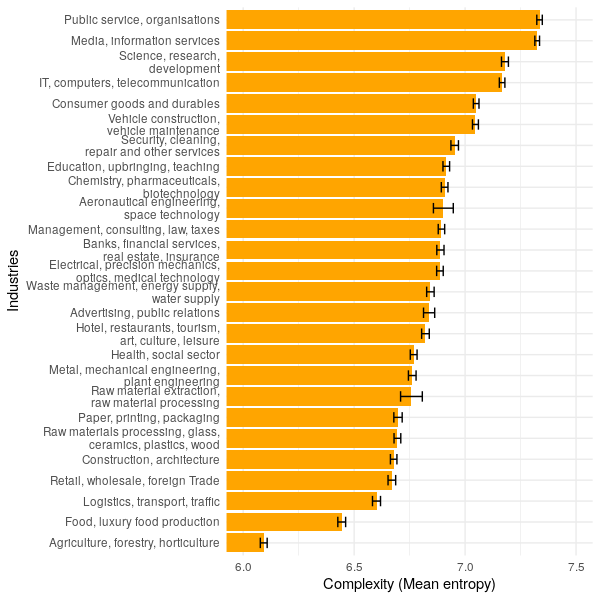
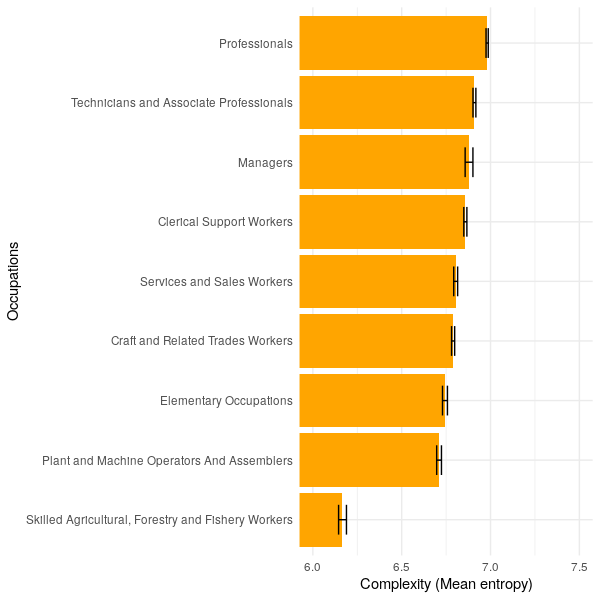
Figure above: Differences in complexity among (left) industries and (right) occupations. Bootstrapped confidence intervals (10,000 re-sampling iterations) reveal significant differences in knowledge complexity (Shannon-entropy of job advertisements) among industries and occupations.
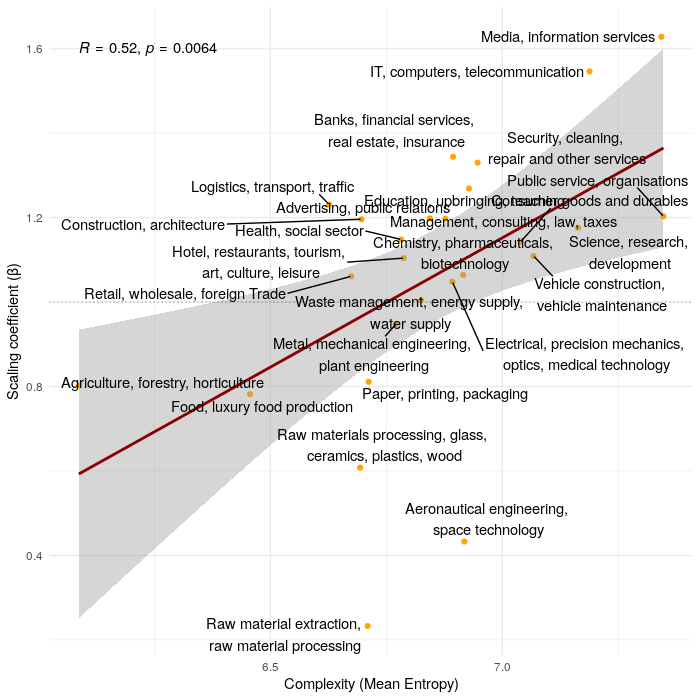
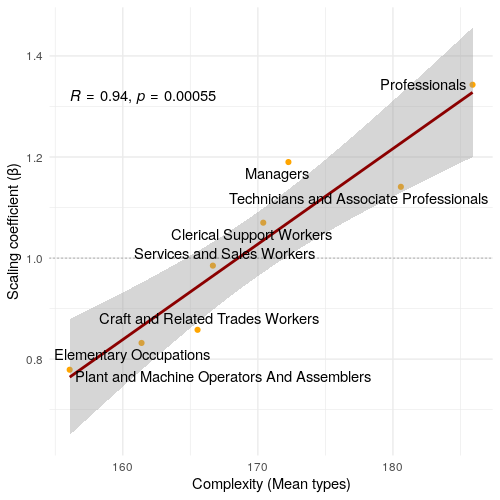
Figure above: Spatial concentration increases with complexity. Higher spatial concentrations of jobs among (left) industries and (right) occupations relate to higher levels of knowledge complexity.
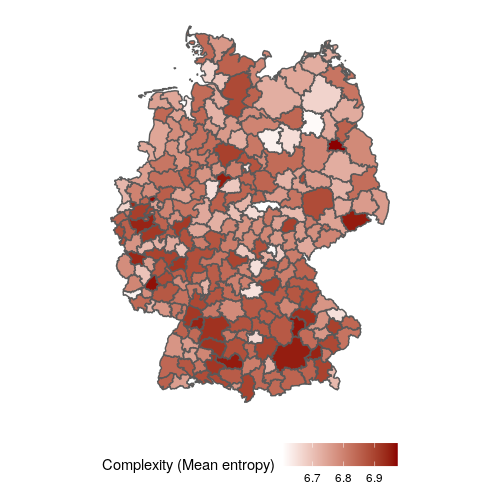
Figure above: Knowledge complexity (Shannon-entropy of job advertisements) agglomerates in large metropolitan areas.
Resources
Find the full thesis here: