Local summary characteristics for marked spatial point processes with composition-valued marks
For my Master’s thesis, I went on a deepdive into the theory of spatial point patterns – a special type of geodata. I developed new statistics to describe such data, tested them in several simulations and applied them to a real world dataset on business-sector compositions in Spain. My supervisor was Dr. Matthias Eckardt. We are currently preparing this work for publication.
Abstract
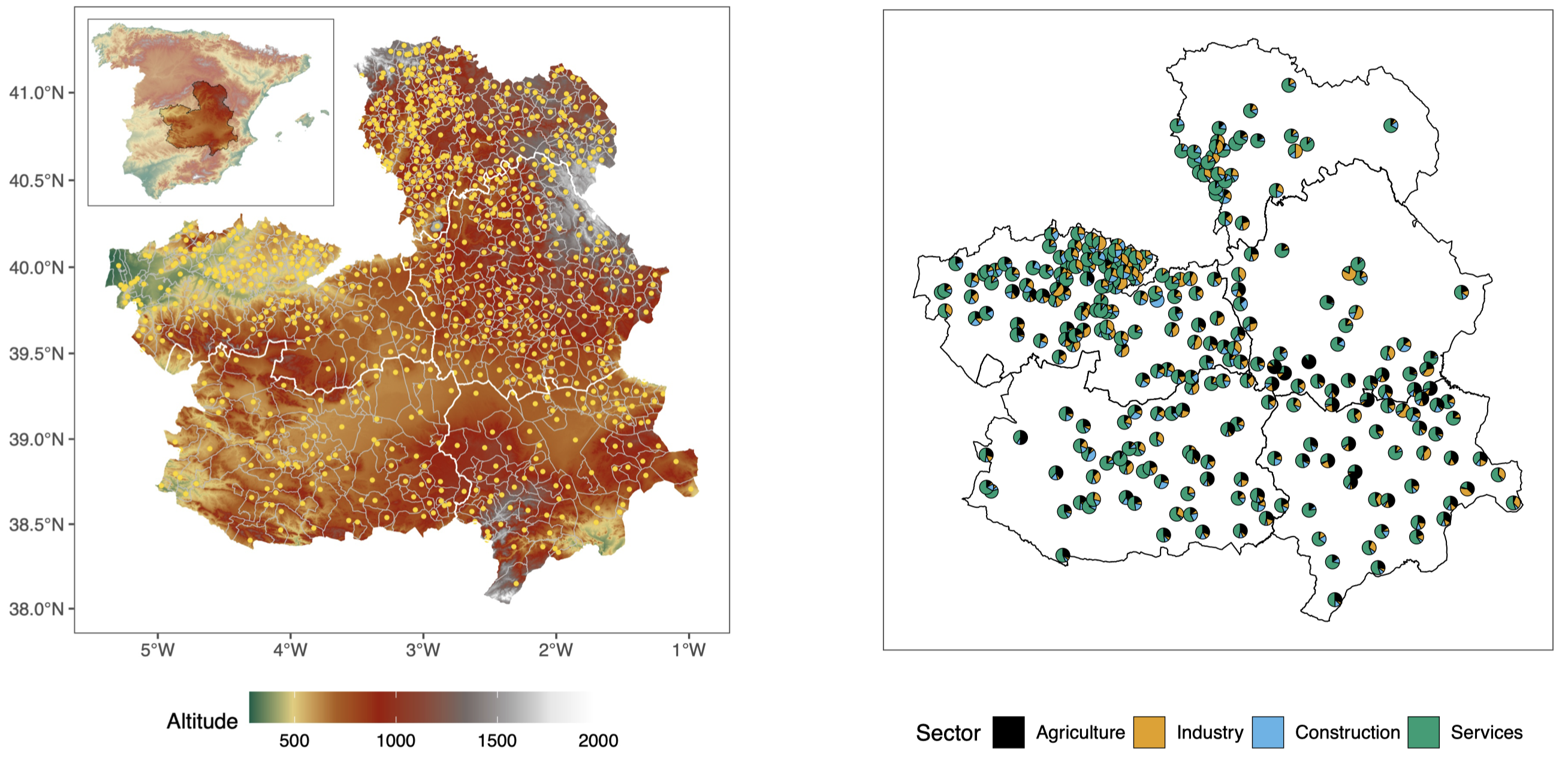
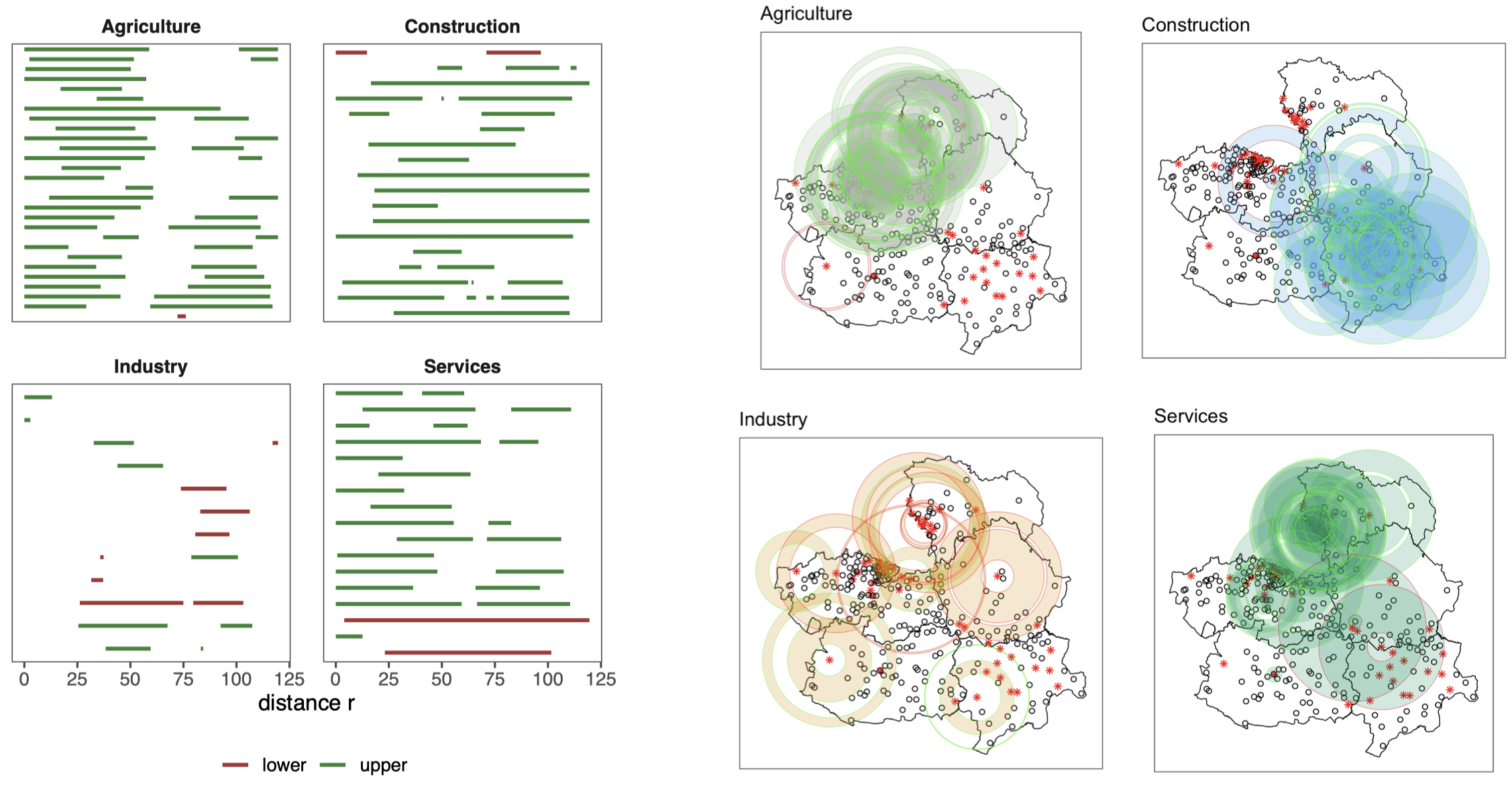
This thesis introduces local summary statistics for analyzing spatial point processes with composition-valued marks, extending existing global methods to provide more detailed spatial insights. Composition-valued marks represent data where each point has associated proportional information that sums to a constant, such as economic sector distributions or voting shares. While global summary statistics provide average patterns across entire study areas, they can miss important local clusters and variations in spatial dependencies. This work develops local versions of key summary characteristics including the mark correlation function, mark variogram, and Shimatani’s I statistic for composition-valued data, using log-ratio transformations to convert compositional data to standard Euclidean space. Through simulation studies across four scenarios, the research demonstrates that local statistics outperform global ones in detecting clustered patterns of mark dependence, correctly identifying 90-91% of dependent points compared to 70-74% for global methods. However, local statistics perform less well with regular spatial patterns. The methods are applied to real-world economic data from the Spanish region of Castile-La Mancha, analyzing employment distributions across four economic sectors for 278 municipalities. The local analysis reveals that agricultural employment shows strong spatial clustering in specific subregions rather than region-wide dependencies, while service sector employment demonstrates more dispersed local associations. This work provides researchers with new tools for fine-grained analysis of spatial compositional data, enabling the detection of local patterns that complement traditional global approaches.
Resources
This presentation provides a brief summary of the thesis (pictures blurred due to compression restrictions):
The whole thesis is available upon request.